Delivered work
TradeSniper
Sole engineer on a production algorithmic crypto-trading platform for ~17 months — application, quantitative and ML signal research, server and communications infrastructure, custom hardware provisioning, and direct customer support, end to end. A scope normally distributed across a multi-person engineering team.
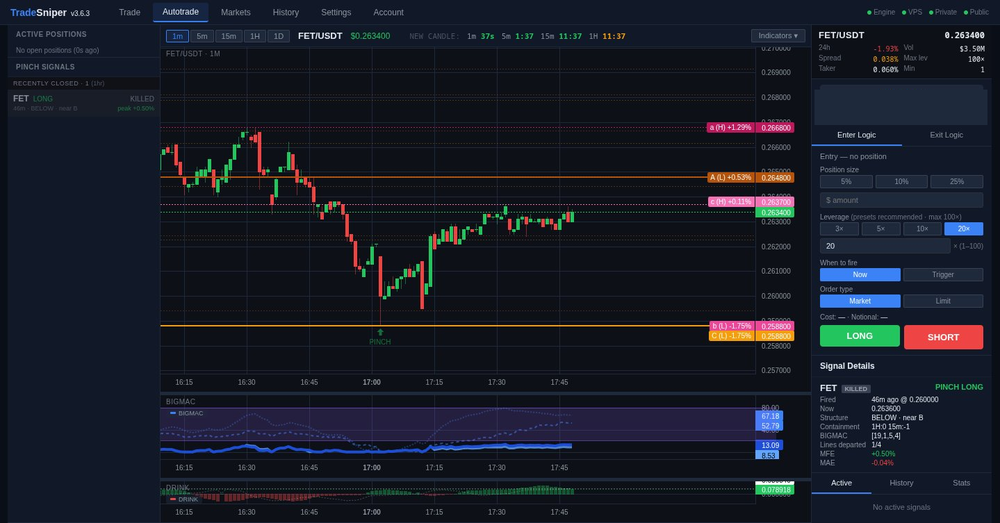
Three architectural generations
The platform grew from a single-exchange utility into a multi-exchange automated system. Each stage was a deliberate re-architecture to match expanding scope — not incremental patching.
Origin — a position-management utility. Active position monitoring and order management with capability beyond native exchange functionality: orders outside the exchange's limit-order window, automated trailing stop-loss. Built on the Godot engine for a high-fidelity custom UI.
Expansion — a runtime pivot. As scope grew to automated, multi-exchange trading, I identified that a game-engine runtime was unsuited to compute-bound backend work and re-platformed the backend to Python — a deliberate trade of UI fidelity for computational headroom.
Maturity — a ground-up rebuild. Re-architected the engine around clean separation of concerns and a ports-and-adapters exchange layer, so new exchanges integrate against a stable internal contract without touching the core. Moved the interface to a browser/Flask delivery model for maintainability and reach.
Quantitative delivery. Developed the platform's core quantitative signal — in production, generating profitable manual-entry signals for live users, with an automated entry layer (state-machine / ML) in development when my engagement ended. Kept a disciplined separation between backtested and live-validated performance: a strategy advances to production only on live validation, never on backtest results alone.
The whole stack, one owner
Alongside the platform I owned the entire supporting stack as sole responsible party: a Stripe integration that automatically linked payment records to user accounts by email, with an admin path to hand-link the accounts that didn't auto-match; custom authentication and account-management backends; VPS security and operations; a self-hosted Matrix/Cinny communications platform built and migrated end to end; and a fleet of turnkey Linux mini-PC deployment units.
The full delivery record — six capability areas with interface screenshots — is available on request. Request the dossier →